
Start With Contra Costa's Voter Lookup
For a current Concord voter, begin at Contra Costa County's My Voting Information page. The county describes the service as a name search that returns registration status and election information tied to a matched voter. It is the practical first stop for confirming a record, a district, or election-day details; it is not an open browsing tool for compiling names from voter rolls. Concord is in Contra Costa County, so the county elections channel, based in Martinez, is the local custodian even though the voter lives in Concord.
| Lookup element | Form or result | Availability | What the county confirms |
|---|---|---|---|
| Name | Text search | Required | The county page confirms a lookup by name. |
| Registration status | Result field | After a match | Shows the voter's registration standing. |
| Districts and officials | Result fields | After a match | Connects the voter/address to districts and elected officials. |
| Polling place and guide | Result field/link | Election-specific | Provides polling-place and voter-information-guide access. |
| Vote-by-mail status | Result field | After a match | Lists the status described on the county page. |
The research could not inspect every live form control, so this table intentionally does not guess whether the current interface also asks for a date of birth, house number, or another matching detail. Use the fields the live county page presents. When a result is missing or needs correction, work with Contra Costa Elections, rather than treating a no-result page as proof that no registration exists.
The County Page Behind a Concord Search
Source: Contra Costa County My Voting Information.
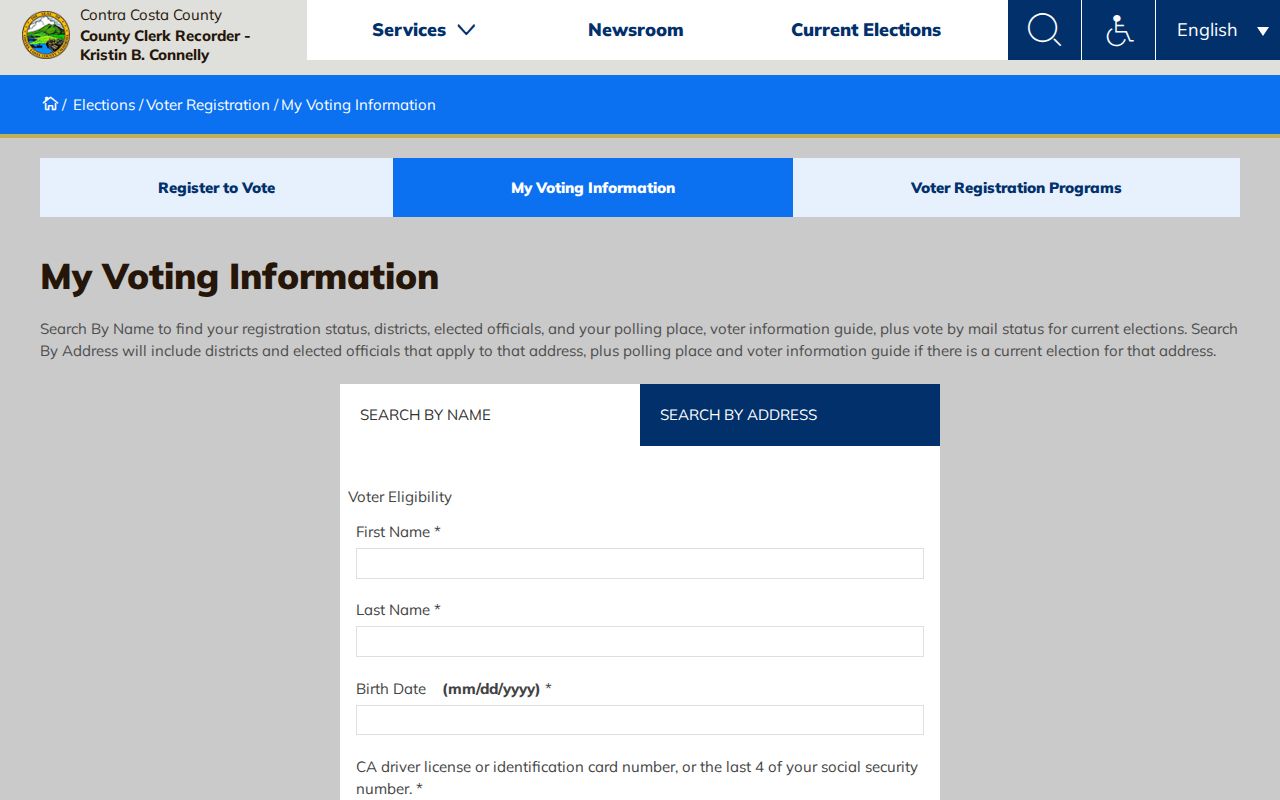
The county service groups registration status with practical election details instead of publishing a general directory. That distinction helps explain why a personal lookup can be useful while wider access to California voter records requires an application, an authorized purpose, and data-handling commitments.
What a California Voter Record Can Contain
Voter registration information can connect a person to a county, address, status, district geography, and party preference. Authorized file access can also include participation history. Participation history identifies elections in which a voter participated; it does not reveal how that voter marked a ballot. A county lookup may surface a smaller, election-focused subset of these facts.
| Voter name | Identifying name associated with the registration record. |
|---|---|
| Residence and mailing address | Registration address and a separate mailing address when supplied, subject to confidentiality protections. |
| County and status | County of registration and a status such as active, inactive, or cancelled where included. |
| Registration details | Registration date and political party preference, including no party preference. |
| District geography | Precinct, districts, and related elected-official geography. |
| Participation history | Elections participated in, never ballot selections or candidate choices. |
These fields do not make voter registration records a general identity database. The official source, the date checked, and the use allowed by law remain part of interpreting any result.
California Keeps Core Voter Details Confidential
Confidential by law. California Elections Code section 2194 makes voter registration affidavit information confidential and limits its release and use. Driver license or state ID numbers, Social Security numbers, unique voter IDs, voter signatures, and protected-address information are not public lookup fields. The law also restricts use to authorized election, scholarly, journalistic, political, or governmental purposes.
That rule applies even where a record has a legitimate public-facing use. It prohibits personal, private, commercial, harassment, advertising, solicitation, sale, marketing, and unauthorized-display uses. A partial address, omitted field, or substitute address is not a reason to infer anything about a voter. It may reflect a legal confidentiality protection rather than a data error.
Safe at Home Can Change the Address Trail
California's Secretary of State operates Safe at Home, an address-confidentiality program for qualifying participants. The program can provide a substitute mailing address that agencies use to limit exposure of a protected residence. In a voter-record context, that means a missing residence address or substitute address should be handled as a privacy safeguard, not as a lead for further probing.
For Concord research, this is especially important because city, county, and state systems use address data for different purposes. A voter address cannot be treated as a property ownership record, a current-location confirmation, or a comprehensive identity profile. Voter registration has its own legal purpose and its own restrictions.
Status Changes Do Not Erase a Voter Record Overnight
California maintains voter rolls through address updates, confirmation mailings, inactive status procedures, cancellations, and federal and state election-law requirements. A voter can become inactive after address-confirmation procedures or undeliverable mail; that is different from being removed simply for missing one election. The precise county workflow should be confirmed with Contra Costa Elections for an individual record.
For someone checking their own standing, the county lookup is the appropriate first step. For a historical or authorized research need, distinguish a current status from the longer record trail and document the source and date of every result. Election information changes with election cycles, redistricting, and record maintenance.
State File Requests Begin With the SOS Process
Source: California Secretary of State voter registration information file request.
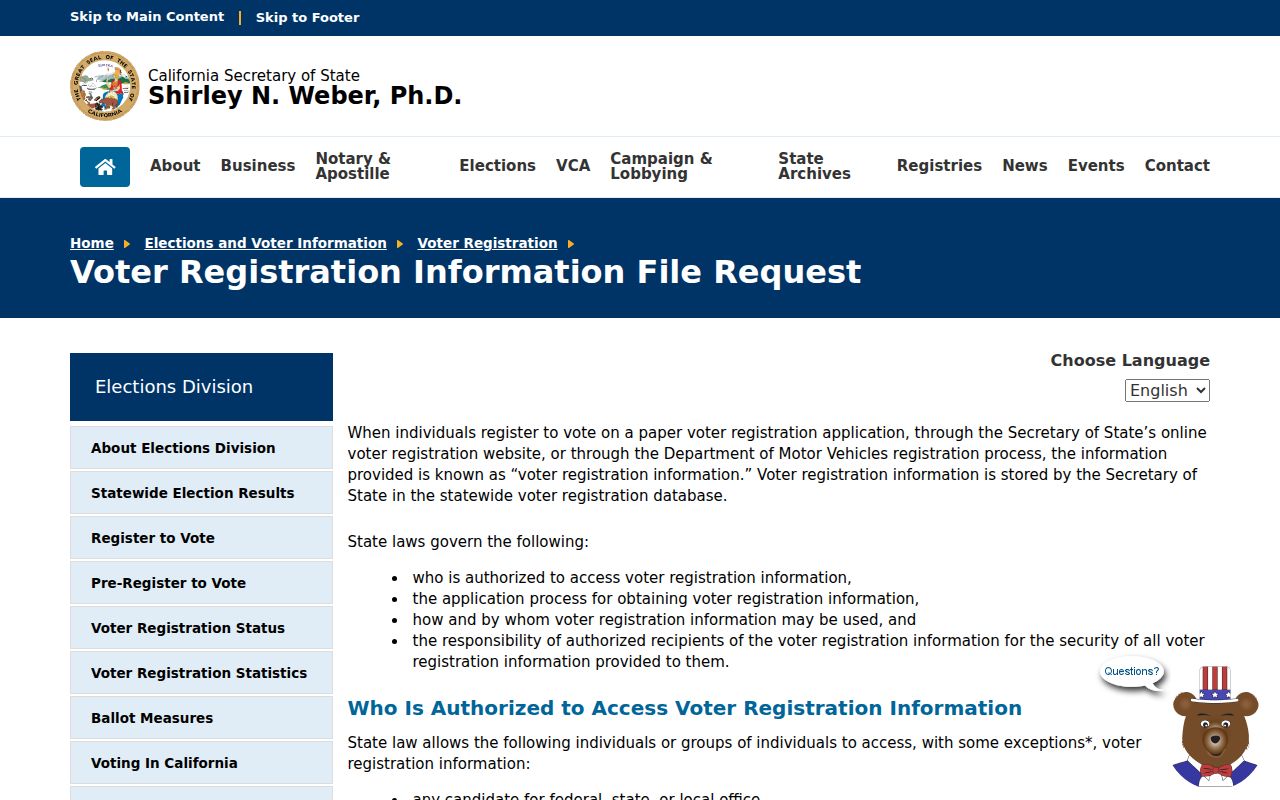
The state route is separate from the county self-service lookup. It is built for a defined request, documented qualification, and a stated purpose. Review the linked request page before beginning an application so that the requested data, authorization category, identification, signature, and delivery method can be planned together.
Requesting California Voter Registration Information
The California Secretary of State's voter-file request process covers statewide data, including Contra Costa County records, under Elections Code sections 2188 and 2194 and SOS regulations. It is not an informal request for a list of Concord names. The application asks the requester to identify the information sought, the intended use, the qualification supporting the request, and any beneficiary when the requester is acting for another person.
- Open the SOS request page and complete the voter-file application with the applicant's full name, residence and business address, phone, identification information, requested data, intended use, and beneficiary information when applicable.
- Select and explain the qualifying purpose and the requested data options. The form includes categories such as political, academic, media, legal, governmental, investigation, and other authorized purposes, along with use and security explanations.
- Attach a current driver license or state ID copy, initial the agreement, and sign the form with an original wet signature. The SOS says applications must be mailed or hand-delivered, not emailed or faxed, and estimates review and processing at 7-14 business days after receipt.
- Pay the applicable fee and receive approved data through the stated secure method. Statewide files may be delivered on encrypted DVD with tab-delimited voter data, voting history, and district files; specific voter records may be sent by encrypted email/WinZip.
| Request type | Published fee | Request limit or delivery note |
|---|---|---|
| Voter information file | $15 per 1,000 records, $15 minimum, $100 maximum | Application, qualification, purpose, ID copy, and original signature required. |
| Specific voter record | $30 each, $100 maximum | Up to 10 records; requested identifiers may include name, date of birth, county, and residence address. |
Authorized Purpose Is Part of Every Voter-File Request
California Elections Code section 2188 requires the application details that make the request traceable, and applications are retained for five years. Elections Code section 2194 prohibits uses outside the allowed election, scholarly, journalistic, political, or governmental categories. It specifically bars personal, private, commercial, advertising, solicitation, sale, marketing, harassment, and unauthorized-display uses.
Misuse has consequences. Elections Code section 18109 makes knowing unauthorized acquisition, use, or misuse of voter registration information a misdemeanor. Use the minimum information needed for the approved purpose, keep it secure, and return to the elections office or SOS for a procedural question rather than extending the record beyond its lawful use.
Older Concord Voter Rolls Need an Archive Search
Current online election tools are not a substitute for historical voter registers or poll books. For older Concord research, the California State Archives is a statewide starting point for county and family-history materials, while the Contra Costa County Historical Society holds early county records, court files, tax assessor books, and physical indexes that can help establish local context.
The county's core historic record trail is centered in Martinez, not Concord. Researchers should search alternate spellings and older place terms, then compare an archival lead with dated newspapers, property records, or probate material. Exact online coverage years for Concord or Contra Costa historical poll books were not verified in the source set, so no particular register is described as digitized or complete.
Keep current and historical sources separate in notes. A modern county result speaks to current election administration, while an archival register may establish that a name appeared in an earlier place and period. Neither source alone resolves identity where names repeat. The most reliable historical approach is to record the collection name, the date range, the spelling used, and any county or precinct reference, then compare that evidence with other dated primary records. Contra Costa's historical materials are valuable precisely because many older name indexes are not part of a current online elections tool.